Pregnancy with Poor Sperm Quality: How IVF Labs Overcome Male Fertility Challenges
Can you get pregnant with poor sperm quality?
The short answer? Yes, pregnancy is possible even with poor sperm quality—thanks to modern IVF techniques that can overcome many male fertility challenges. However, success depends on how poor the quality is and what advanced methods are used in the lab. Here’s what you need to know.
What Is Considered "Poor Sperm Quality"?
According to the WHO 6th edition semen analysis standards, poor sperm quality may include:
Low sperm count (oligospermia): <15 million/mL
Poor motility (asthenozoospermia): <32% progressive movement
Abnormal morphology (teratospermia): <4% normal-shaped sperm
High DNA fragmentation: >30% damaged DNA
Even with these issues, IVF (especially ICSI) can help achieve pregnancy—but the lab must use specialized techniques.
How IVF Labs Handle Poor Sperm Quality
1. ICSI (Intracytoplasmic Sperm Injection)
What it does: A single sperm is injected directly into the egg, bypassing motility and penetration issues.
Success rates:
Normal sperm: 65-75% fertilization rate
Poor motility/morphology: 50-60% fertilization rate
Severe cases (e.g., <1% normal forms): 30-40% fertilization rate
2. Advanced Sperm Selection Techniques
Physiological Intracytoplasmic Sperm Injection (PICSI) is a technique used in IVF to select mature sperm for fertilization
Best For - Low motility and high DNA fragmentation
How It Works - Sperms bind to hyaluronic acid in a specialized dish (indicates sperm maturity)
Magnetic-Activated Cell Sorting (MACS) is a sperm selection technique used to isolate healthy sperm from those that are undergoing apoptosis (programmed cell death)
Best For - High DNA fragmentation
How It Works - Specialized magnetic beads are coated with antibodies that bind to proteins on the surface of damaged sperm cells
Intracytoplasmic Morphologically Selected Sperm Injection (IMSI) is a technique used to examine sperm in great detail before selection and fertilization
Best For - Severe morphology issues
How It Works - Uses a 6000x magnification high-powered microscope to pick the best-shaped sperm and healthiest nuclear structures
3. Testicular Sperm Extraction (TESE/microTESE)
For azoospermia (no sperm in the ejaculate)
Success rates:
Obstructive azoospermia: 80-90% retrieval success
Non-obstructive azoospermia: 40-60% retrieval success
Why it helps: Testicular sperm often have lower DNA damage than ejaculated sperm.
Check out this story from Brienne and Eric when they sought a male infertility specialist, Neel Parekh, for microTESE.
That story is heart warming and typical for male infertility cases, but sperm extraction can also be useful for other medical emergencies. Check out this story about Raul Rodriguez and his journey to love and fatherhood.
4. Sperm DNA Fragmentation Testing & Repair
Tests: TUNEL, SCSA, or SDFA
Solutions if high:
Antioxidant pretreatment (CoQ10, vitamin E)
MACS sperm sorting
Using testicular sperm (lower DNA damage)
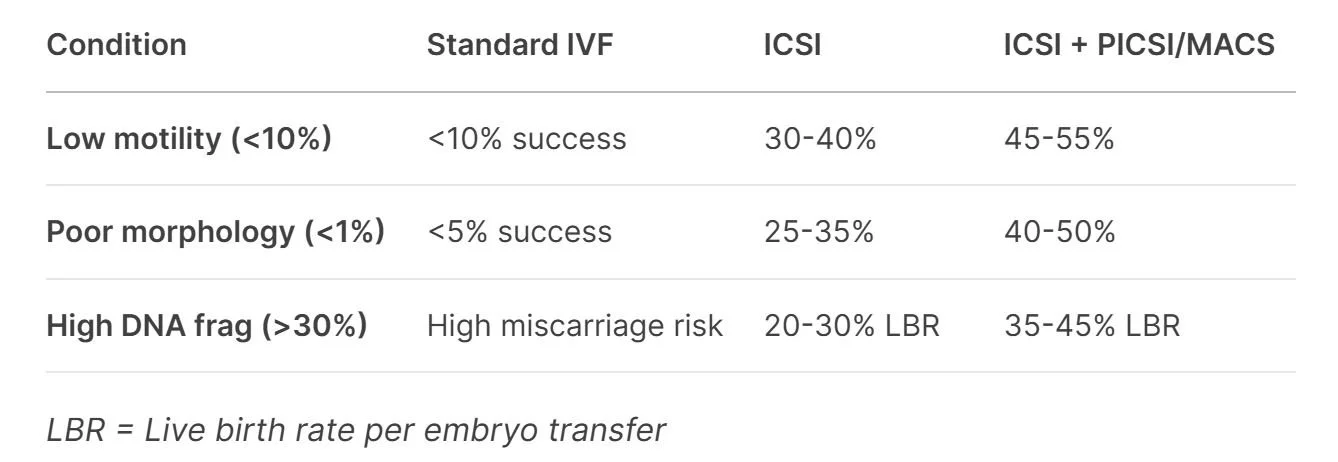
Real-World Success Rates with Poor Sperm Quality
Can Lifestyle Changes Improve Sperm for IVF?
Yes! If you’ve been following The IVF Kitchen, then you’ve already heard our experiences with patients who started with poor sperm quality, but were able to turn it around. 3-6 months of pretreatment can significantly improve sperm quality:
Quit smoking (↑ motility by 20-30%)
Reduce alcohol (↓ DNA fragmentation)
Antioxidants (CoQ10, vitamin E, zinc)
Varicocele repair (↑ count/motility in 60% of cases)
Bottom Line: Yes, Pregnancy Is Possible
Even with severe sperm issues, IVF with advanced sperm selection can lead to successful pregnancies. The key steps:
Test DNA fragmentation if motility/morphology is poor.
Use ICSI + PICSI/MACS for better sperm selection.
Consider testicular sperm if DNA damage is high.
Optimize lifestyle for 3+ months before IVF.
While poor sperm quality reduces natural conception chances, modern IVF labs and advanced research have created powerful tools to overcome these challenges, making fatherhood possible for many men who would have had no options just a decade ago.
“They don’t make sperm like they used to”